Linguistic features of digital code: analysis on the performative materiality of code
Abstract
Digital code is a formal language designed to execute specific functions within the digital environment of a browser and other software programs used in digital media. The characteristics and functionality of code can, to some extent, be described and analysed with theories and research methods developed in linguistics. This approach to digital media reveals similarities and differences between formal languages and natural language and processes, which take place in the digital context. My research is focused on the creation of digital aesthetics and originates from the observation that everything that appears on the screen of a digital device is programmed with code, and that code not only describes the elements and animations that can be seen on the screen but also performs the actions to make these elements and animations appear on the screen. It follows that there is a relation between code and User Interface, and that code has a performative materiality.
Introduction
Digital media can be analysed at different levels and from different perspectives because in modern societies, digital media and web technologies are ubiquitous and have shaped and informed communication, trading, working, but also thinking and learning. It might therefore be a daunting task to define the field of research when it comes to analysing a medium that has affected our culture, work, and education at large. One approach to digital media could begin with the observation that everything that can be seen and done on the screen of a digital device is programmed with code, and given that code is a formal language, it might be possible to investigate digital media by studying code as a language in order to understand and appreciate its functionalities and characteristics.
In the present essay, I summarise the insights of my PhD research study on digital aesthetics that I have undertaken at Kingston University London. My study is designed as research-led practice, a variation of the practice-based research method. My practice consists of the creation of enhanced e-books in EPUB3 format and is informed by linguistic theories and concepts, which I demonstrate with the practice. The EPUB3 format can be described as a ZIP archive containing files of HTML, CSS, JavaScript and SVG and presents many features known from web pages. These technical features set the EPUB3 document midway between print and digital culture, as it presents concepts, designs and practices of both realms.
The practice helped gain first-hand experience with web technologies and direct insight into the structure and the system of web technologies and the code files. I could recognise that digital code does have several similarities, as both are underpinned by syntactical and semantic rules, and are descriptive and performative. The main difference between the two types of language is that human language was developed and is used in a socio-cultural context, while code only exists and functions within the digital environment of a browser and other software programs. Consequently, features of human language like creativity, ambiguity, and the phenomena of diachronic, diastratic, diaphasic and diamesic variations fall short in digital code, which in turn is designed to execute precise functions, and must be precise and unambiguous. This distinction is a first step towards the analysis of the characteristics of code, as it sets apart formal language from human language. A further insight is that the materiality of code is mathematical and can only be revealed through compiling, the process that converts source code into machine code and generates strings of binary code called tokens, while the materiality of human language is physical and natural, as it originates from the phonatory system of human beings.
These are the parameters which define the field of study in the four dimensions of natural language, formal language, source code and machine code. The characteristics of the two types of language and their respective contexts in which they occur can be analysed with the theories of structural linguistics. The model of communication developed by Roman Jakobson provides the tools to describe the context and the functionalities of both languages, while the linguistic characteristics can be described with the concepts developed by Ferdinand de Saussure.
Given that digital aesthetics is understood in this research as the result of a process inside the digital environment of a browser, code can further be analysed with the Speech Act theories to describe and analyse the performativity of code. This process is strongly tied to the materiality of code and the environment that hosts it, for which reason I will always refer to the performative materiality of code.
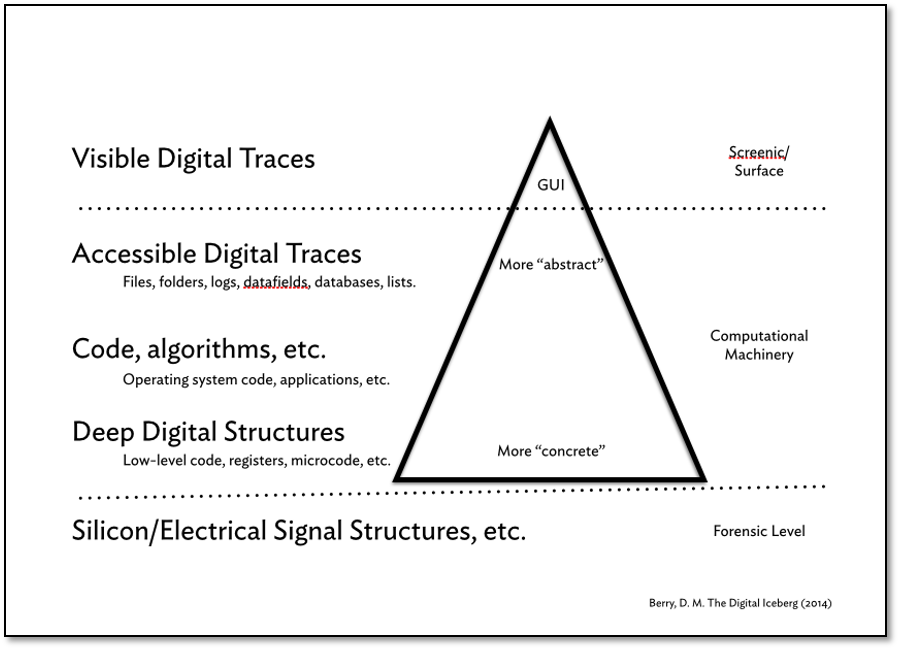
Besides linguistics, literary studies can also help analyse the linguistic characteristics of code, in particular the research work in electronic literature, which combines literature with new media technologies. Many scholars of electronic literature have pointed out the fundamental role of code in the creation of works of literature, music and art, and in general, the innovations brought by web technologies in all other aspects of life. For my research on digital aesthetics, I follow the theory of postdigital aesthetics proposed by Kim Cascone, according to whom the study of digital media requires shifting the attention towards the data hidden in the tools. For this reason, I approach digital media with the Media-Specific Analysis theory, developed by Katherine N. Hayles, and look at the digital environment below the screen to investigate what David Berry has come to define as the “digital iceberg”.
1 Linguistic theories and characteristics of language
Digital code is human-readable because it is designed and meant to be used by humans. Code does, however, have the primary function of enabling communication between humans and the computer and providing a set of instructions that the browser can read, interpret and execute to perform specific tasks. In fact, code strings are written in such a way that some parts are read by the browser and remain hidden inside the machine, and other parts become visible on the screen, which are usually contained in the brackets of the code string. Mark Marino’s “Manifesto” of Critical Code Studies (Marino, 2020, p. 36) opens with exactly this example using the famous test message “Hello, World” to demonstrate the two types of language, in this case, Lisp (List Processing Language) and human language.
(DEFUN HELLO-WORLD ()
(PRINT (LIST 'HELLO 'WORLD))
The argument proposed in this manifesto is that computer code could and should be analysed as a text, not in function of the computer program but as “a text, a sign system with its own rhetoric, as semiotic communication that processes significance” like human language and thus adopting research methods like critical hermeneutics and literary analysis developed in the humanities. This is an example of how code could be analysed, and that coding has socio-cultural implications, but it is based on the premise that “code exists not for machines but for humans who need to communicate with the machine and with other humans.” (Marino, 2020, p. 38) This argument is refuted by the opposite idea that code has no semantics because it is designed for the browser and not for people. The difference between the two types of language is that “one can be executed by the computer one cannot.” (Raley, 2006) Code thus presents features that are similar to human language and is further determined by the digital context that hosts and runs it. For these reasons, code can be analysed with theories and concepts developed in structural linguistics to highlight the linguistic features of code and identify the characteristics of formal languages, and pragmatic linguistics to describe code’s performance.
1.1 Structural linguistics
Some features of human language are presented in Ferdinand de Saussure’s “Course in General Linguistics” (de Saussure, 2013), notably published posthumously in 1916 by his colleagues. In his study, language is described as a system that connects a concept with a word, for which reason the linguistic sign has a double articulation defined as signifier, the word used to refer to a concept, and signified, the concept that the word refers to. Based on these observations, it follows that the linguistic sign is subject to arbitrariness, insofar as words, meanings, and syntactical structures are developed and established by a given linguistic community. Further, the linguistic sign is linear and discrete, as every sentence and every word is composed of elements that are produced within space and time and are mutually related. The system and the convention that shape language are variable because language is subject to socio-cultural variations. These changes occur on two different levels due to the dual nature of the linguistic sign. On the one hand, language is a social construct and defined by rules, which de Saussure calls langue (language in French), and, on the other hand, language is used individually and differently by any single member of the linguistic community, which is the physiological and practical use of language, called parole (speech in French). This is how the phenomena of diachronic, diastratic, diaphasic and diamesic variations can be explained. Human language is a natural language and exists in a socio-cultural context.
The same principles apply to digital code, since machine language or types of code like HTML, CSS and JavaScript, to name those relevant in the EPUB3 document, are formed like human language, or American English to be precise. An HTML code is composed of an attribute name and an attribute value, which define and organise the elements in the HTML code file. A CSS code has to be understood as a rule applied to an element and is divided into a selector, which names the element that the rule is applied to, and a declaration, which determines how the properties of that element are to be styled. A JavaScript code describes a function and is formed by a function and the respective method, parameters and arguments, which contain the information for the function.
All these elements are written in human-readable language and designed to describe the structure, styles and functions of elements like text, images, videos and animations that appear on the screen. At the level of source code, which is also called the high level of abstraction, code works in the same way as human language, except for the fact that it can only be executed within the digital context. This is because digital code is an artificial language and is designed to provide precise instructions to the machine.
Code’s function can be better understood when analysed in the broader context of the browser, and the various passages of its performance are highlighted. For this purpose, we can resort to the communication model developed by Roman Jakobson, which describes the constitutive factors for communication and the functions of language, both formal and human. As Jakobson wrote in his seminal essay “Closing Statements: Linguistics and Poetics”, the constitutive factors for the communication between an addresser and an addressee are a context which makes the message operative and a code that is common to both parties – also defined as encoder and decoder – and there needs to be a physical channel or psychological connection, defined as contact. (Jakobson, 1960, p. 353)
Figure 1: Factors for a communication model according to Jakobson.
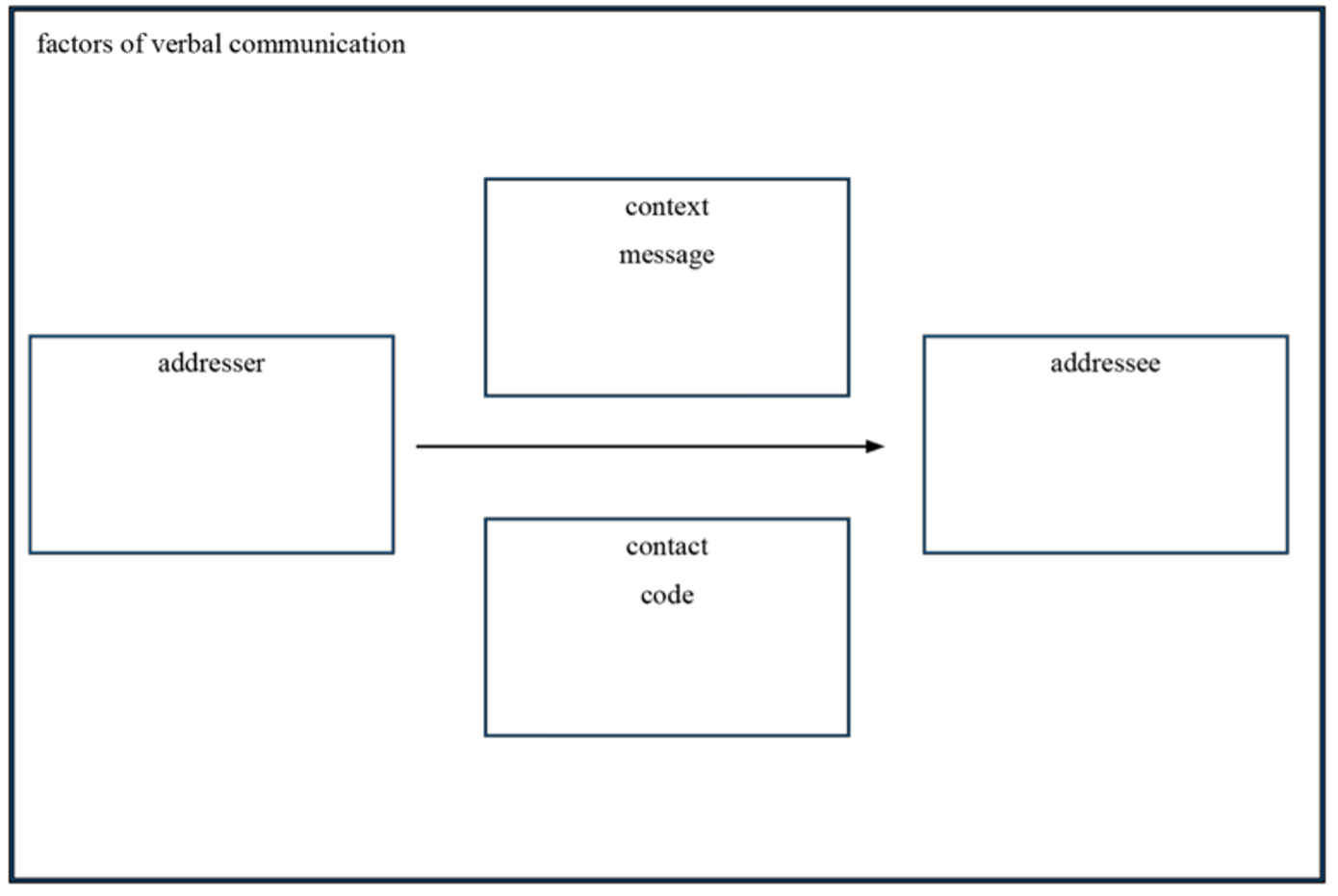
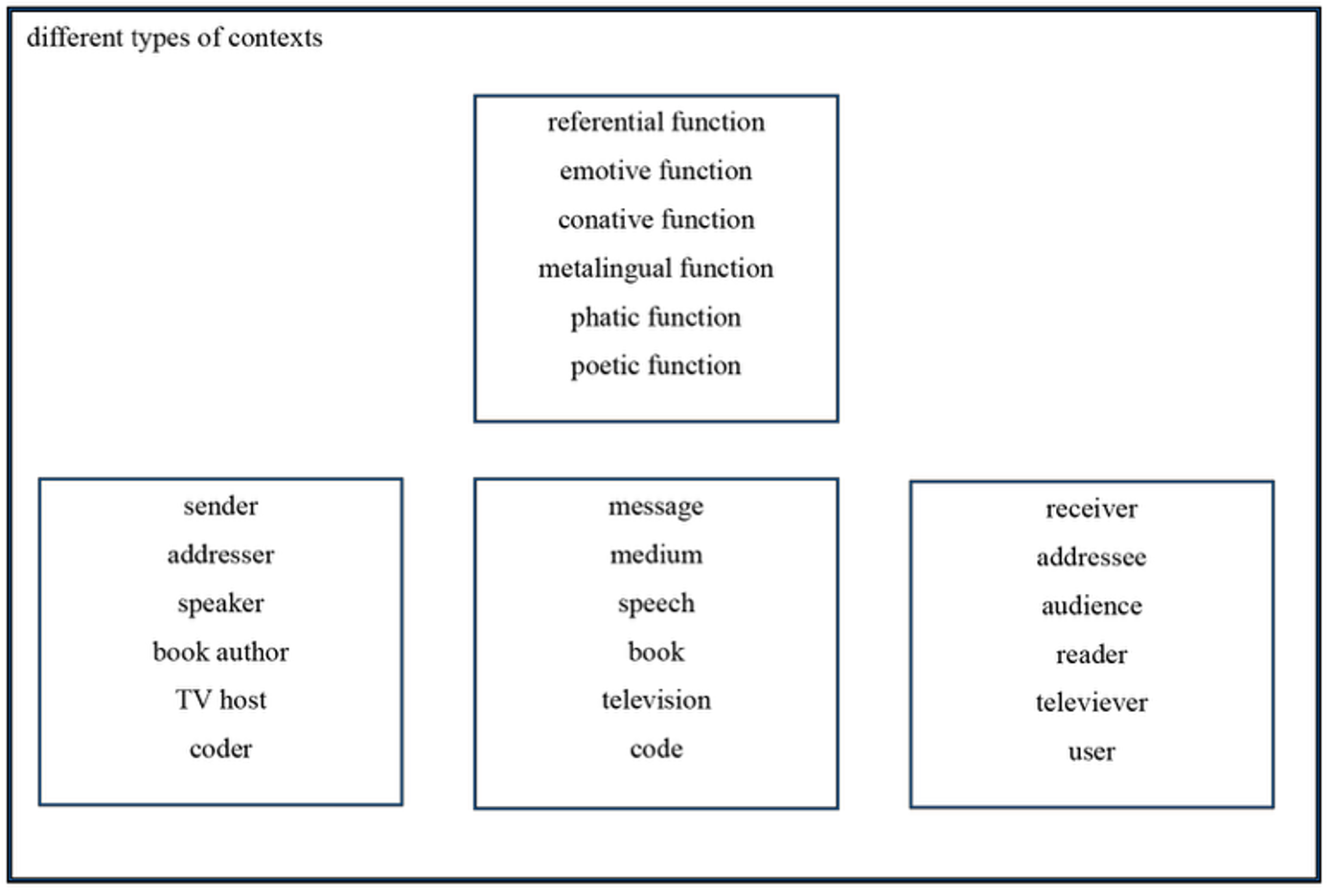
Each of these constitutive factors determines a different function of language. The addresser has an emotive function, which defines feelings and emotional traits of the utterance; the conative function is the way how the message can influence the addressee, as is the case in commands; the referential function provides descriptions and information about the context in which the communication takes place; language can also be used to verify whether the communication channel works, which is called the phatic function. Language can also be used to talk about language, and this function is called metalinguistic; finally, the function oriented toward the message is called poetic and focuses on how the message is communicated.
This model applies well to the analysis of the functions of language in digital media, but also other types of media like the printed book, radio, and television, where the roles of addresser and addressee change accordingly. In the digital context, the addresser and the addressee become the coder and the browser, and the message becomes the digital code, which is not to be confused with the code in the scheme of the constitutive factors.
Figure 2: Functions of language according to Jakobson.
Following the Media-Specific Analysis, which serves as a general approach to my field of study, the model of communication developed by Jakobson sets the basis for the description of the interplay between code and browser and the different functions of code in the process of the creation of digital aesthetics or instantiations. In new media, the analysis turns to the medium-specific digital nature of the environment of the browser code itself. The functions and the performance of code, and the relations between code and the browser, have to be interpreted within the characteristics of the digital context. This acknowledgement is fundamental for the study of new media because every type of development of web technology has to be traced back to the efficiency of the design of code. And as Tenen argues, the innovations brought by the digital medium reveal that code as machine instruction “embodies new forms of technological control” and that critical theory needs to acknowledge “the mechanisms of its codification”, which calls, ultimately, to “a strategy of interpretation capable of reaching past surface content to reveal platforms and infrastructures that stage the construction of meaning.” (Tenen, 2017, pp. 3-6)
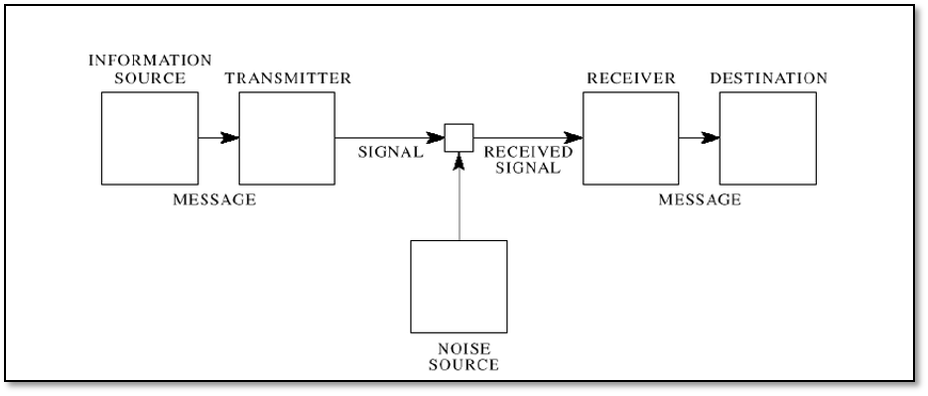
At the same time, Jakobson's methodology allows for the expansion of the research to the neighbouring discipline of computational semiotics. Another model of communication (Figure 3), developed by Claude E. Shannon and Warren Weaver in the 1940s, offers a more detailed description of the communication process into the mechanisms of input, output, signifier and signified. Not only did this model set the basis for Jakobson to develop his own model, but also for the discipline of computer semiotics, which provides methods to study code’s ontology to describe the ‘being’ and ‘doing’ of code (Tanaka-Ishii, 2010, p. 71) where being is understood as “the ontological status of an entity whose ontic character is established by what it is,” this means, what features programming languages have; whereas doing “denotes that of an entity whose ontic character is specified by what it does and by what can be done to it” and focuses on the functions of code.
Figure 3: Model of communication according to Shannon and Weaver.
(Source: Shannon and Weaver, 1963, p. 7)
Therefore, the Media-Specific Analysis of digital media gestures towards the analysis of the syntactical, semantic and performative aspects of code supported by the digital materiality of the browser. Further, the theories and concepts developed in linguistics and semiotics provide the keys to describing and understanding code’s performative materiality and its role in the creation of digital aesthetics.
1.2 Pragmatic linguistics
My research hypothesis originated from the curiosity to understand how code could create digital aesthetics and if it was possible to describe the process that takes place in the software program with linguistics, given that code presents many similarities with human language. The varied phenomena observed by linguistics in regard to the formation, recursiveness and variation of language reveal an inherent dynamic, which is active, generative, transformative and performative. This secret life of language induced me to find a way to build a theory which explained the performative ability of code and the creation of digital aesthetics. Eventually, I found such a theory in Johanna Drucker’s work in digital aesthetics and speculative computing, which is the Speech Act Theory.
This theory was developed by various linguists and philosophers like John Rogers Searle and Jürgen Habermas, but it mainly follows the work of John L. Austin, who summarised his lectures on this topic in his seminal book “How to Do Things with Words” (1962). As Drucker explains, this theory has been adopted in many disciplines, but “the fundamental concept remains the same: that a word, action, or behavior effects change, rather than simply stating, describing, or representing an idea, thought, feeling, or expression.” (Drucker, 2009, p. 202, note 6)
Code’s performance is described by Drucker with the concept of performative materiality, which is the “readerly production of texts, and beyond, to a probabilistic perspective”, which means that the creation of meaning always involves a reader or user as opposed to the theory of literal materiality, which tends to “assign intrinsic and inherent values to material properties in the analysis of digital artifacts as an extension of literary and critical studies.” (Drucker, 2013) While Drucker understands the theory of performative materiality as a criticism of literal materiality, to shift from structuralist to post-structuralist concepts, my research moves in the opposite direction to investigate code’s materiality, which renders it performative.
Austin’s book deals mainly with performative utterances, which he categorises into three different types of speech acts. The locutionary act, which is “the act of saying something” (Austin, 1962, p. 94), the illocutionary act, which he defines as a “performance of an act in saying something as opposed to performance of an act of saying something” (Austin, 1962, pp. 99-100) and the perlocutionary act, which “produce[s] certain consequential effects upon the feelings, thoughts, or actions of the audience, or of the speaker, or of other persons.” (Austin, 1962, p. 101) Another aspect of this theory, which is also relevant for the discourse on the performative materiality of digital code, is that these speech acts become orders and actions in specific circumstances and are based on social conventions, such as naming a ship, Christian marriage in a church, or a bet, to use Austin’s examples (Austin, 1962, pp. 8-9). Transferred to new media, this means that code is only performative in the digital context, as it can only exist and function if read, interpreted and executed by a browser.
Therefore, according to the Speech Act Theory in the digital context, as described by Jakobson’s model of communication, the writing of code strings equals a locutionary act, as this is the basic act of communicating; the description of the instruction equals the illocutionary act, which is then performed; and the effect of this instruction results in a specific behaviour in the user, which can be defined as the perlocutionary act. In the case of HTML and CSS, the perlocutionary act is the displaying of content with specific styles, shapes and colours, while the perlocutionary act in JavaScript corresponds to various effects, such as triggering animations, executing functions through the users’ interaction or input.
Literary theories
The theories presented so far reveal the materiality and functionality of code and that code not only serves to describe elements and animations that appear on the screen, but also performs the actions to create these same elements and animations. This implies that code plays a fundamental role in the creation of digital aesthetics, and the improvement of digital devices and user experience. In broader terms, these aspects of digital media are directly linked with their digital materiality. This observation could be inferred from the examples presented so far in this essay; however, in her analysis of electronic literature and her attempt of creating a methodological framework, Katherine N. Hayles explains that “(…) within the humanities and especially in literary studies, there has traditionally been a sharp line between representation and the technologies producing them. Whereas art history has long been attentive to the material production of the art object, literary studies has generally been content to treat fictional and narrative worlds as if they were entirely products of the imagination.” (Hayles, 2002, p. 19)
This distinction aligns with the discourse on the linguistic features of code, as code’s performative materiality is informed by the digital materiality of the software program that hosts it and underpins the entire process of creating digital aesthetics, and shaping the outcome in the form of text, image, and animation. Many scholars of electronic literature, like Hayles, Portela, Cayley, Glazier, Rayley, Pressman, and Marino, have pointed out code’s materiality and function in the creation of digital literature and art and the importance of taking into account these characteristics to better understand digital media and digital culture at large.
The same scholars recognise that many characteristics of electronic literature, such as reader’s interaction, world creation, algorithmic processes, multilinearity and multimodality, to name a few, are not exclusive to literary works supported by digital technology, but are also present in many works of print literature, which the critic has generally defined as experimental literature. These insights gained from literary studies are pertinent to the topic of my essay, because electronic literature, which could best be defined as “a first-generation digital object created on a computer and (usually) meant to be read on a computer” (Hayles, 2008, p. 3) offers a tool to interrogate the medium that produces it, in the same way as experimental literature of the print tradition does with the concepts and the design of the content and the shape of books, which go down to the characteristics of language.
2.1 Experimental literature
The history of literature is rich with examples of printed books that challenge the basic concepts of the standardised design of a book and its parts, and the way they are meant to be used. The concept of the book has been developed for more than 500 years, since the invention of the printing machine by Johannes Gutenberg, which is conventionally set in the year 1450. During these five centuries, typographers and printers have created the different text parts, like page numbers, footnotes, and indexes, and styles and layout elements like italic fonts and headers, footers, gutters and indentations, to name a few, which eventually have become standard elements of all books as we know them today.
These elements and the use of textual parts of a book are now part of common knowledge, to the extent that readers don't even realise that these elements and textual parts execute functions and guide the reading. These elements and the use of textual parts of a book are now part of common knowledge, to the extent that readers don't even realise that these elements and textual parts execute functions and guide the reading. Especially, in the 20th century, many authors, artists and scientists gathered in different schools of thought, which experimented with the materiality and functionality of language and the printed book. Among these schools of thought are Futurism, Dadaism, Surrealism, Gruppo 63, OULIPO, and ALAMO, which emerged between 1910 and 1980 and were mainly influenced by the rise and development of types of media, such as the radio, the cinema, the telegraph, the telephone, and the computer.
2.2 Electronic literature
Electronic literature is inextricably linked with computers insofar as it is supported by hardware and software programmes and is designed to be played and read on digital devices. Indeed, many technical features that characterise works of electronic literature can only work within the digital system, and the centrality and fundamental importance of the digital medium can be considered a criterion to define electronic literature as a distinct literary genre.
While there have been a few examples of literary works created with computers between the 1950s and 1960s, such as “Love Letters” (1952) by Christopher Strachey, “Stochastische Texte” (1959) by Theo Lutz, and “Tape Mark I” (1961) by Nanni Balestrini, the beginning of the history of electronic literature can be set in the year 1982, with the foundation of the publishing company Eastgate Systems, which created and published works of electronic literature, which coincided with the ever growing production of personal computers. The subsequent creation of the World Wide Web and commercial browsers between 1989 and 1999 led to a further development of this literary genre, as works could be published on websites, blogs and social platforms.
As the name suggests, electronic literature combines literary practices with technology, and the resulting works usually take the name of the technology are the logic that underpins it, such as hypertext novel, interactive fiction, locative narrative, generative poetry, e-poetry, kinetic poetry, netprov or networked improvised literature, and codework. What is relevant to highlight in my argument on digital aesthetics is that electronic literature is an artistic expression of digital culture, and it has the peculiar capacity to interrogate the medium that supports it. Just like experimental literature in print culture can reveal and challenge the design of books and their textual parts and graphical elements by techniques of omission, exchange, rupture, and play, so can electronic literature shed light on the inner workings of the computer in a constant dialogue between User Interface and code. The rupture of publishing conventions shows that the innovative and provocative techniques applied in these digital and print works are inherent in the language and the materiality used to create them.
3 Source code and machine code
As a formal language, code has affinities with human language in that it is underpinned by syntactic and semantic rules and can perform actions, but differs from human language in that it can only operate within a digital environment and must be precise and unambiguous because it obeys machine logic. While code reveals linguistic features and performativity, in terms of the Speech Act Theory, it reveals nothing of its materiality. The browser reads, interprets and runs the rules and functions written with HTML, CSS and JavaScript, but doesn’t show how it intervenes in the inherent dynamism of language, mentioned above.
The linguistic analysis of code doesn’t explain how the digital materiality affects code’s performance, in the way that, on the contrary, the distinctive features of speech explain the various phenomena of human language. This is due to the fact that the browser doesn’t read code as it is written in human language, but transforms source code, at a high level of abstraction, into machine code, at a low level of abstraction.
3.1 Source code
Source code can be analysed with linguistic theories because it is designed to be read by human beings and to build a bridge between human logic and machine behaviour. Source code reveals the similarities with human language, and many scholars of digital media have stressed code’s fundamental role in the creation of digital aesthetics through the interplay with the browser.
The design of source code, however, isn’t completely satisfactory as it doesn’t allow access to the digital materiality, which could explain code’s nature and dynamic that makes its performance possible. It is not satisfactory even at a theoretical level because human logic clashes with machine logic, and the interplay between source code and browser can never be complete and coherent. These explanations are to be searched at the lower level of abstraction of code.
3.2 Machine code
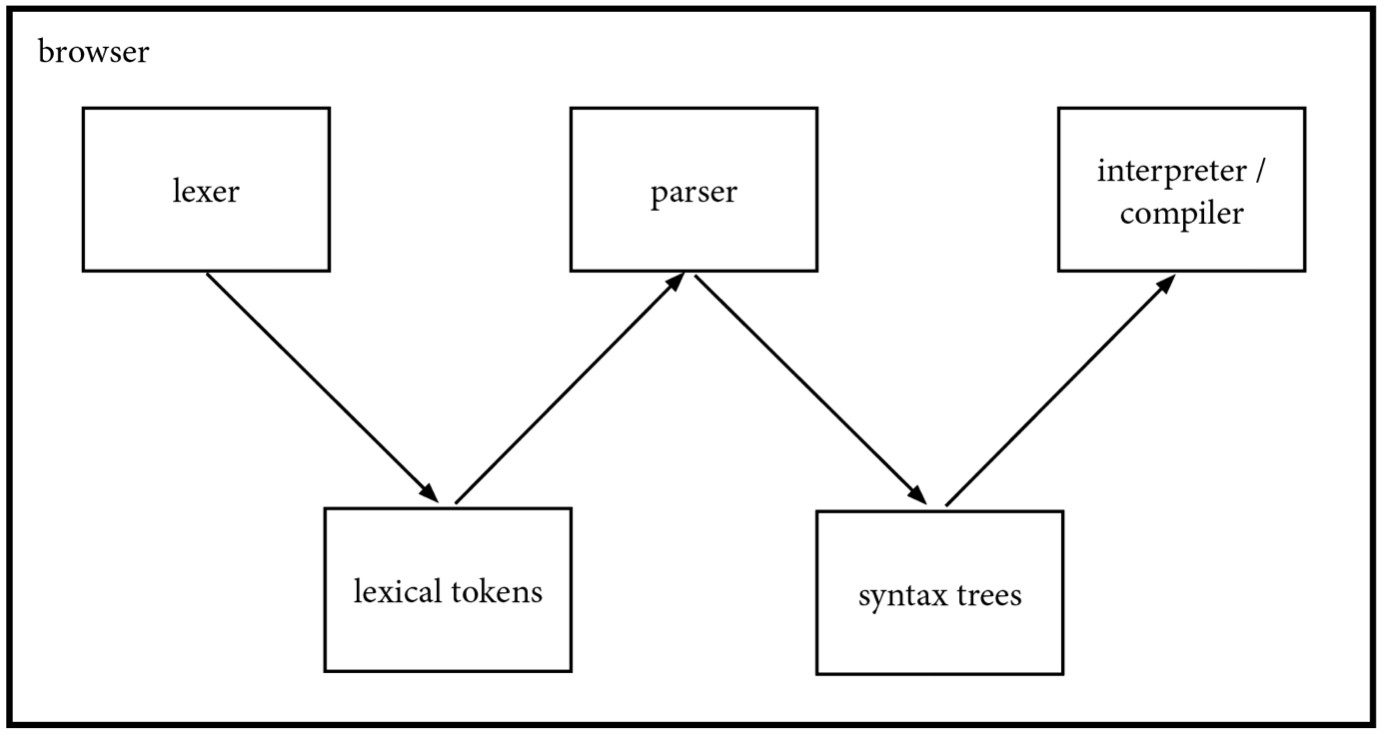
When it comes to reading, interpreting and executing, the browser operates at the level of machine code, which consists of strings of binary code. This process of transformation, called compiling (Figure 4), starts with a lexer, which scans the code files and divides them into a sequence of classified tokens, also known as lexemes, based on their functions, such as numbers, identifiers, operators, and keywords. These descriptions are called regular expressions, and the tokens define an element according to their type, value and position. It is only at this point that the machine code is forwarded to a parser in the form of streams of tokens. The parser structures the data retrieved from the streams of tokens into a tree diagram consisting of nodes that denote constructs. Once the tokens are recombined in a tree diagram called Concrete Syntax Tree (CST) or Abstract Syntax Tree (AST). The browser can then interpret the machine code and attach a meaning to the single elements of the tree diagram and understand their functions, which equals a semantic and pragmatic analysis of machine code. The interpreter executes the program’s logic, and the browser engine, also called a rendering or layout engine, renders the code and turns it into elements and actions visible on the screen (Mogensen, 2024).
Figure 4: Process of code compiling
This insight is important for at least two reasons. On the one hand, it serves to investigate the materiality of code and its inherent dynamics, which cannot be found in source code. On the other hand, it expands the field of research of digital aesthetics to the lower level of abstraction of code and validates the theories according to which, digital media must not (only) be analysed on the surface of the screen on which the elements and animations are visible, but above all beyond the screen in order to discover, describe and understand the functioning of the medium and the characteristics of code. Below the screen, there are multiple layers to be taken into account when it comes to analysing the digital media, as is shown with the metaphor of the digital iceberg (Figure 5). Curiously, the analysis of machine code can be proceeded with linguistics as tokens, lexemes, syntax, and semantics are concepts belonging to the domain of linguistics.
Figure 5: “Digital Iceberg”.
(Source: Berry and Dieter, 2015, p. 47)
Conclusion
The research shows that an attentive and critical analysis of code’s functionalities and characteristics can shed light on the code files and the digital environment, which shape and inform digital aesthetics. Aspects like the materiality and the performativity of code, and the logic and functionalities of the browser help understand the relation between code and digital aesthetics. These relations that underpin digital media can be described with the concepts of mathesis, graphesis and aesthesis, as described by Johanna Drucker.
Starting with the assumption that code is material, and that “the mathematical form of code” defined as mathesis, is the “real materiality of code” code can be distinguished into the two levels of abstraction high and low, where the latter “exists independent of human perception” (Drucker, 2009, pp. 135-136) and processed by the browser. Graphesis refers to the “knowledge manifest in visual and graphic form” and is based on the understanding of “form as replete, instantiated, embodied, discrete, and particular,” which is visible on the User Interface as code’s “formal expression” (Drucker, 2009, p. 140) Ultimately, aesthesis is “the generative perception and cognitive production of information and its material expressions in any medium” and is “dependent on recognition of the cultural and historical characteristics of visual forms, their materiality, and the theoretical assumptions built into formal expressions of knowledge. (Drucker, 2009, p. 128) In other words, aesthesis is the aesthetics of digital media, of the User Interface, more broadly, digital aesthetics, as I have come to define it in my research. The term aesthesis refers to the subjective and sensorial experience of the audiovisual effects of digital media and is filtered and interpreted through historical and cultural notions.
However, the description of the different levels of code also brings to light the relationships between machine code, source code, and User Interface aesthetics and explains the tokenisation process. The stages of lexical and syntactical analysis in the lexer and the parser are manifestations of mathesis, as the words in the source code are turned into streams of binary code and classified, structured and processed with an algorithm. The rendered machine code becomes visible on the screen, which is a manifestation of graphesis, while the users’ interaction with the audiovisual elements of the User Interface falls into the realm of aesthesis.
Ultimately, Drucker concludes that the analysis of digital aesthetics should also include machine code as “[t]he digital encoding of form as information, as data, as patterns of binary code might be used to assert that our understanding of what a form is should shift toward the realm of mathesis.” (Drucker, 2009, p. 140) The analysis of machine code reveals the structure and the materiality of source code and serves as the basis for the understanding of the process, which occurs in the interplay between code and browser and the creation of User Interface aesthetics.
References
AUSTIN, J. L. How to do Things with Words. Edited by URMSON J. O. and SBISÀ M., second edition. Cambridge, Massachusetts: Harvard University Press, 1962.
BERRY D. M and DIETER M. Post-Digital Aesthetics. Art, Computation and Design. London, UK: Palgrave Macmillan Verlag, 2015.
DE SAUSSURE, F. trans. HARRIS, R. Course in General Linguistics. London, UK: Bloomsbury Revelations, 2013.
DRUCKER, J. SpecLab. Digital Aesthetics and Projects in Speculative Computing. Chicago, USA: University of Chicago Press, 2009.
HAYLES, K. N. Writing Machines. Cambridge and London: The MIT Press, 2002.
HAYLES, K. N. Electronic Literature. New Horizons for the Literary. Indiana, USA: University of Notre Dame Press, 2008.
JAKOBSON, R. Linguistics and Poetics, 1960.
MARINO, M. Critical Code Studies. Cambridge and London: The MIT Press, 2020.
MOGENSEN, T. Æ. Introduction to Compiler Design. Third Edition. Cham, Switzerland: Springer International Publishing, 2024.
PORTELA M. Scripting Reading Motions. The Codex and the Computer as Self-Reflexive Machines. Cambridge and London: The MIT Press, 2013.
SHANNON C. E. and WEAVER W. The Mathematical Theory of Communication. Chicago, USA: University of Illinois Press, 1963.
TANAKA-ISHII, K. Semiotics of Programming. Cambridge, UK: Cambridge University Press, 2010.
TENEN D. Plain Text. The Poetics of Computation. Stanford, California, USA: Stanford University Press, 2017.
Essays
CASCONE K. The Aesthetics of Failure: “Post-Digital” Tendencies in Contemporary Computer Music. Computer Music Journal, 24 (4): 12–18, 2000.
DRUCKER J. Performative Materiality and Theoretical Approaches to Interface. DHQ: Digital Humanities Quarterly, Volume 7, Number 1, 2013.
RALEY, R. Code.surface || Code.depth. UC Santa Barbara, 2006.